

Artists
Welcome to the Artists page. This is for anyone with an interest in a particular artist. Members can send in a summary of the research you have done on the background of your chosen artist. Give readers a feel of the type of person they were, plus when and where they lived. You could talk about their style of painting and maybe refer to some examples of their work. Maybe you might like to tell readers where they might be able to view some of the artist’s work.
Please remember to scroll down the page to see articles on other artists.
Caravaggio
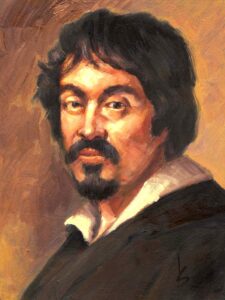 I started on an OU MA course (A840) ‘History of Art’ and was fascinated by the first part which was dedicated to the artist Merisi Da Caravaggio (born in Caravaggio and named after his birthplace). His father was a stonemason, but some family members died of bubonic plaque when Caravaggio was young. Caravaggio moved to Rome to learn painting. An early work entitled ‘Self-portrait as Bacchus’ shows the artist’s great use of light and dark. He used to openly carry a sword and apparently swaggered about the city, and he became well known to the local police as he had a fiery temper and was often involved in arguments.
He was a great observer of society and painted a picture of a card sharp at work. He was renowned for painting life as it was – ‘warts and all’. He accepted a commission to paint a large altarpiece for a church. The religious painting ‘Penitent Magdeline’ was revealed to the congregation who allegedly openly gasped as the main figure was modelled on a local ‘Woman of the night’ the whole work was in complete variance to the accepted idealism of artists such as Michelangelo. During a tennis match Caravaggio started a dual with his opponent who subsequently died from stab wounds. Caravaggio was banished from Rome, and he fled to Naples where he resumed his paintings. Following more problems he fled to Malta obtaining protection from the Knights of St John. He wanted to return to Rome but missed a ferry and died trying to run after it.
I later paid a visit to the Dublin Art Gallery to marvel at the painting ‘Betrayal of Christ’ (one of only about fifteen known existing paintings by Caravaggio) and I had the pleasure of eavesdropping as a group of children were having the picture explained.