

This page is for collectors, and all those with a particular interest in nostalgia. We look back at the history of any object that might have a significant to your life. Choose a particular group of objects, be it something that can be collected in the home or something that can be compared out in the wider community or even some aspect of life. Then try doing a little bit of research and let us know what you found out. Oh yes, and don’t forget to send us a photo that is applicable to your piece.
Please remember to scroll down the page to see the research of other people.
Sindy Dolls
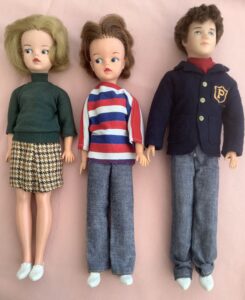 Sindy, a 12-inch British fashion doll, was introduced at the beginning of the ‘Swinging Sixties’ in 1962, along with a range of fashion-conscious clothes, and went on to become the best-selling teenage fashion doll in Great Britain. There was hardly a girl in Britain who has not possessed a Sindy doll at some time in her life, Sindy’s popularity having no barriers of social status or class. She was Britain’s answer to America’s much more glamorous (and some would say brash) Barbie, but she was more like the ‘girl next door’ with her wholesome English rose looks, sensible size 10 figure (her measurements would be 33-24-34) and range of fashions. Sindy was also accompanied by her boyfriend Paul and kid sister Patch, the dolls’ clothes originated from designers such as Mary Quant, Hardy Amies and, latterly, David and Elizabeth Emmanuel.
The Sindy doll was officially introduced to toy retailers at a special event on Friday 6th of September 1963 held at the Associated Rediffusion TV Studios, Wembley, London. She was subsequently introduced to little girls at 6pm on Monday 30th September after the children’s evening programming with a 30 second TV commercial in the London area. The advert only advertised Sindy. She was the first UK toy to have an advert dedicated solely to herself. The advert with its catchy jingle was shown twenty-five times up to Christmas Day and included her first eight outfits and eight separates.
She went on to win the National Association of Toy Retailers ‘Girls’ Toy of the Year’ award in 1968 and 1970. Pedigree produced Sindy for twenty-three years, and as the times and tastes changed, so did Sindy. Her original blonde, brunette or auburn (red) bubble hair cut was, according to a Daily Mail article published in 1964, created by Michael of John of Knightsbridge. Later she was given other hairstyles, both long and short. There were always blonde, brunettes and auburns to choose from.
In 1986 Pedigree sold the rights to Sindy to the American toy giant Hasbro Inc. Hasbro remodelled the doll to look more American but as Mattel’s Barbie continued to grow in popularity and enjoy continuing market growth, Sindy’s declined, which eventually led to her being delisted from major retailers in 1997 and Hasbro returning the doll’s licence to Pedigree. There is research into Pedigree’s much-loved doll from 1963 to 1985 and the outfits that were available for her.
If you are lucky enough to find the original doll and the original clothes (they have Empire made label on them)., they command a lot of money.
Margaret Stobirski Region 08